
The Monarch in Me
Talking the insect, not royalty. Danaus plexippus.

I was sitting on my stoop, sunbathing.
I do this in the morning sometimes, especially when the night has been cold and my bungalow’s ambient temperature hasn’t yet caught up with the day’s warmth. I make my coffee, let the cat out, and sit there, staring at the other units of the bungalow court as my bones gratefully soak in the sun.
It only takes a couple minutes of sitting in the direct sunshine to feel adequately irradiated. It’s all my milk-white skin can really handle, and even in the winter, after returning indoors, my eyes take some time to adjust back to the less brilliant interior of my home.
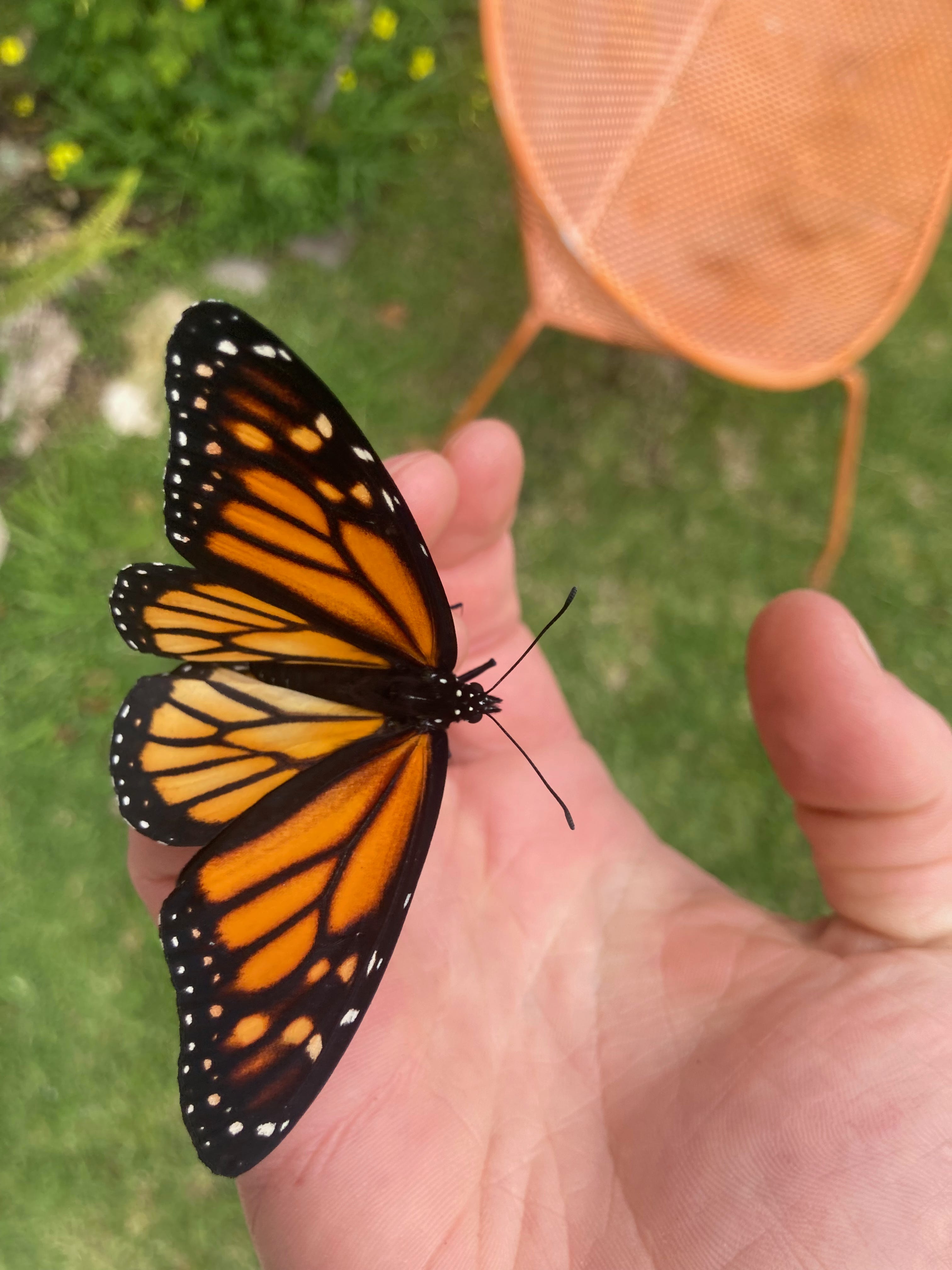
Within that two minutes however, I got to witness an occasional visitor to the bungalow court. Swooping in from the sky, a monarch arrived to survey the scene.
For a long time, it fluttered. Floating about the larger of the milkweed bushes, it seemed hesitant to land. To another bush, smaller, the flowers more yellow than orange, it wafted about, then abandoned that one too without touching down. Off to my neighbor’s yard it explored, and flittered around another neighbor’s home, with no milkweed or flowering bushes to offer succor.
It seemed confused, this monarch. Like a man who’s misplaced his tan Camry in a Walmart parking lot. It got close to one plant, then another, yet remained foiled.
I wondered why it didn’t just land. Take a beat. Take a rest. A little drink of nectar, maybe. There were plenty of open blooms.
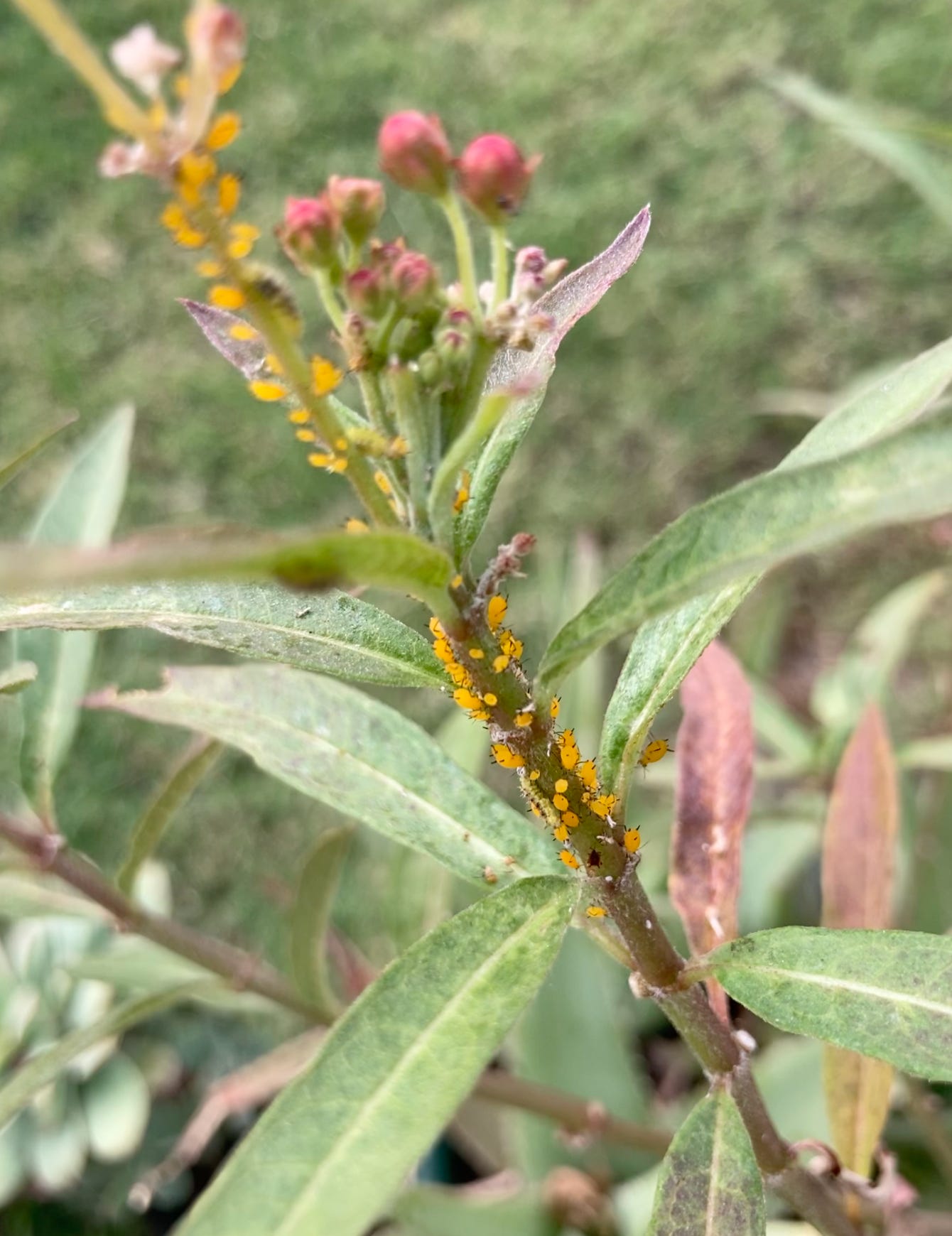
Perhaps it wanted to lay some eggs. It didn’t like these particular bushes. Maybe it saw the bright-orange kissing bugs, which lay in wait like assassins, concealed in the foliage.
***
I have long struggled with the concept of home. Technically speaking, Los Angeles is my home. It is where I spend most of my time. It is where I was born. It’s where all of my immediate family live. I have dear friends here. A community that is the envy of nearly every outsider I have brought into its periphery.
The people that come in droves to Los Angeles, the dreamers—musicians, artists, actors, creatives of all kinds—they are usually quite captured by it. They say, “Wow, Nick, what a wonderful community you have”. I must agree with them. It is wonderful.
And yet, at other times, I am forced to wonder. Why do I feel so lonely here? So adrift. So lacking… a sense of orientation.
***
The monarch population is split into two varieties—migratory, and non-migratory. Genetically, they are the same species, yet some genes are expressed in one that aren’t expressed in the other.
In the Eastern United States, all monarchs are migratory. Their entire community makes a many thousand mile journey from Mexico to Canada that can span 4-6 generations. The return trip however, is completed in its entirety by a single “Super Generation,” one which suspends certain metabolic functions in order to travel, uninterrupted, for 8-9 months.
***
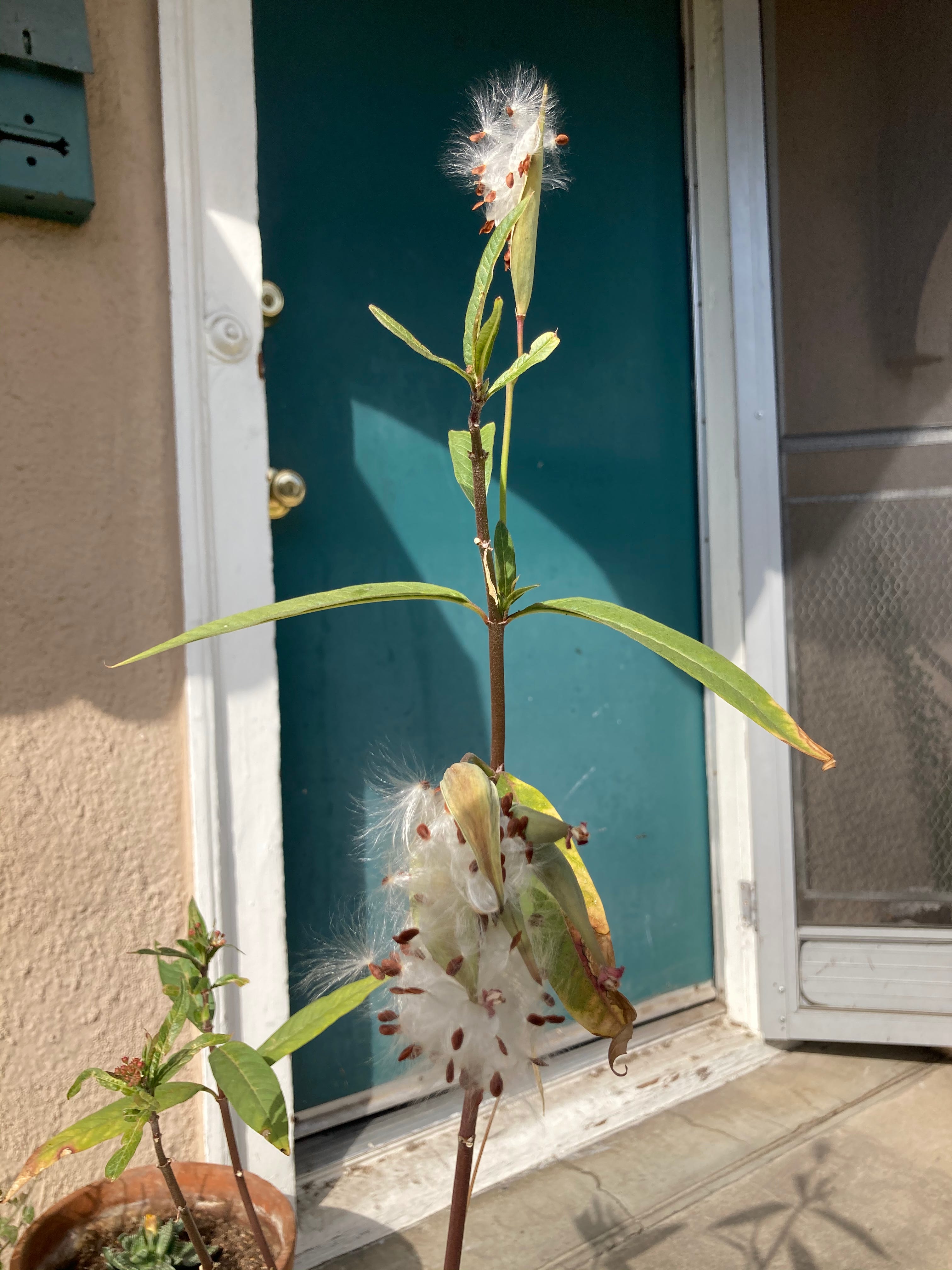
It occurs to me that there used to be another milkweed plant growing from one of my potted plants on the stoop. It was a small pot, devoted to a variety of red spiny euphorbia I do not know the name of, in which a milkweed seed, floating on a tuft of its own cotton, had landed and taken root.
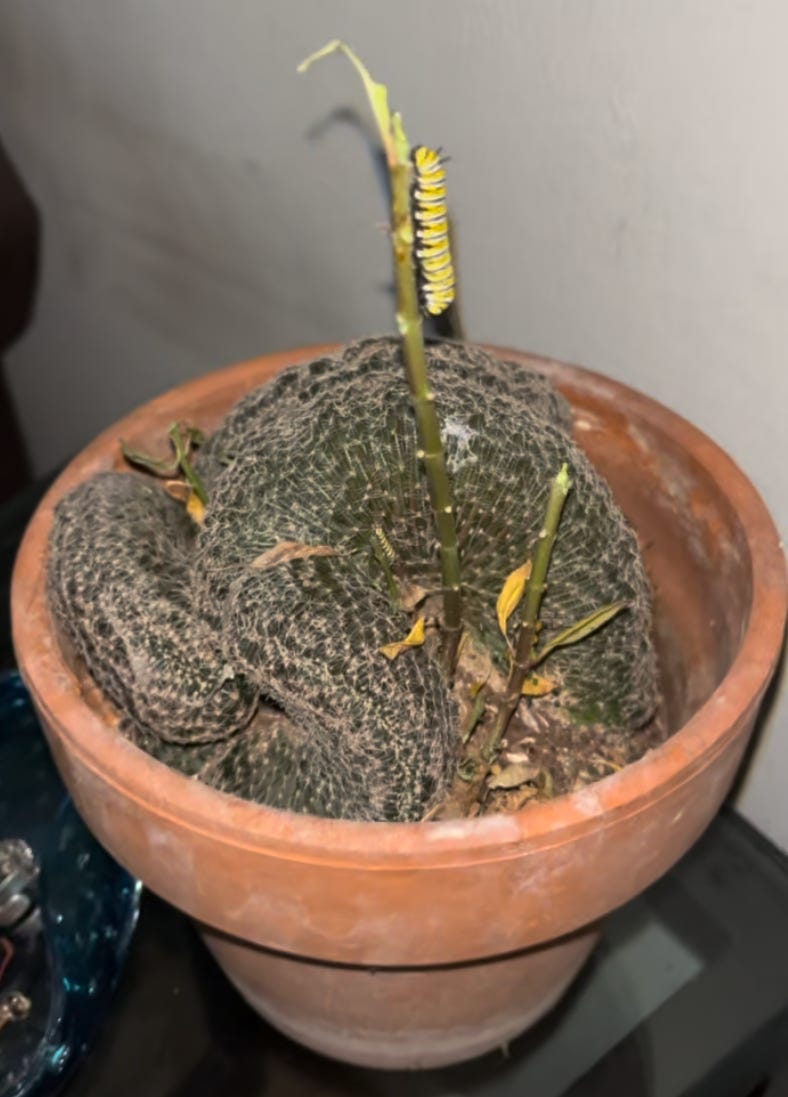
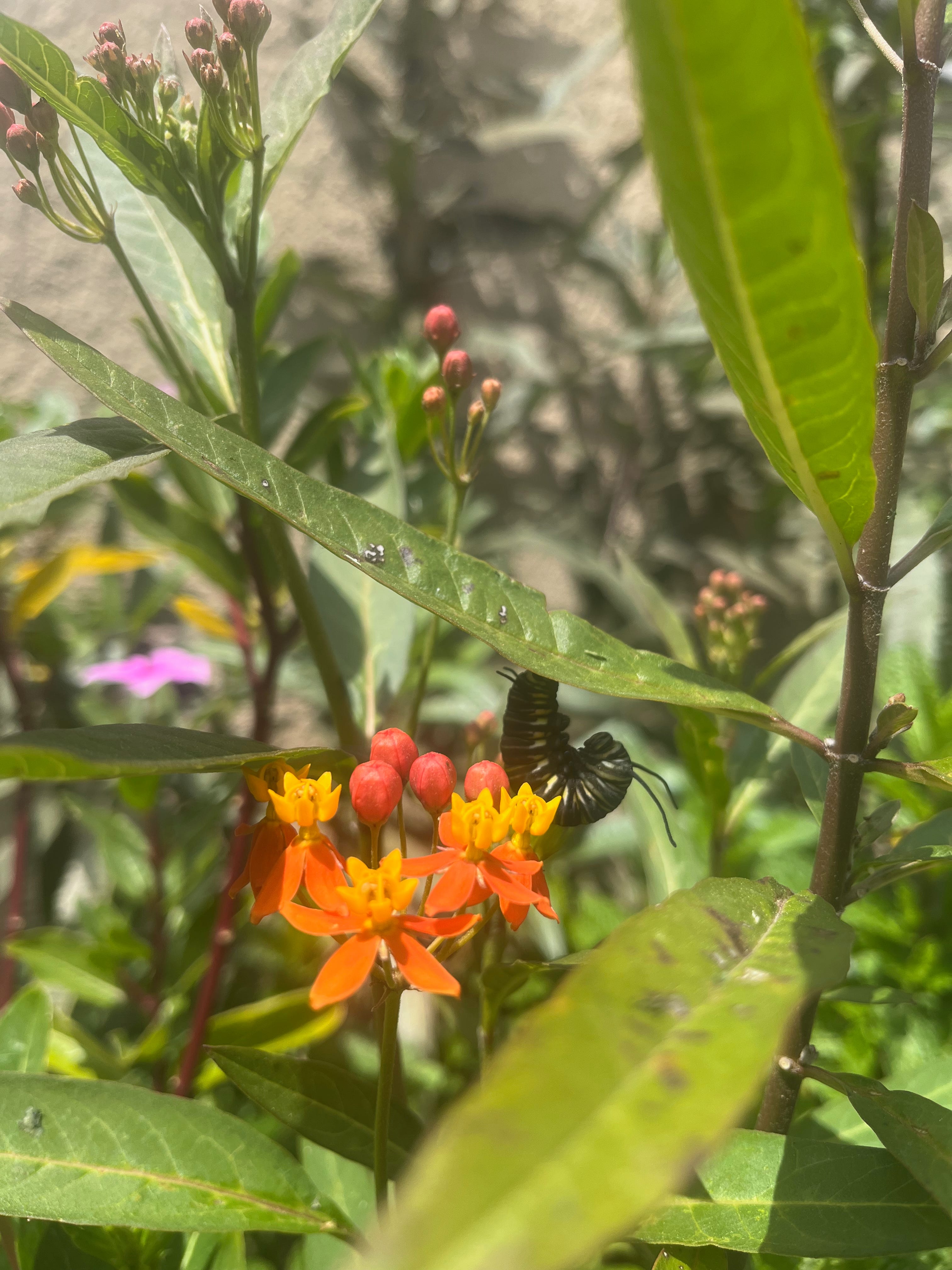
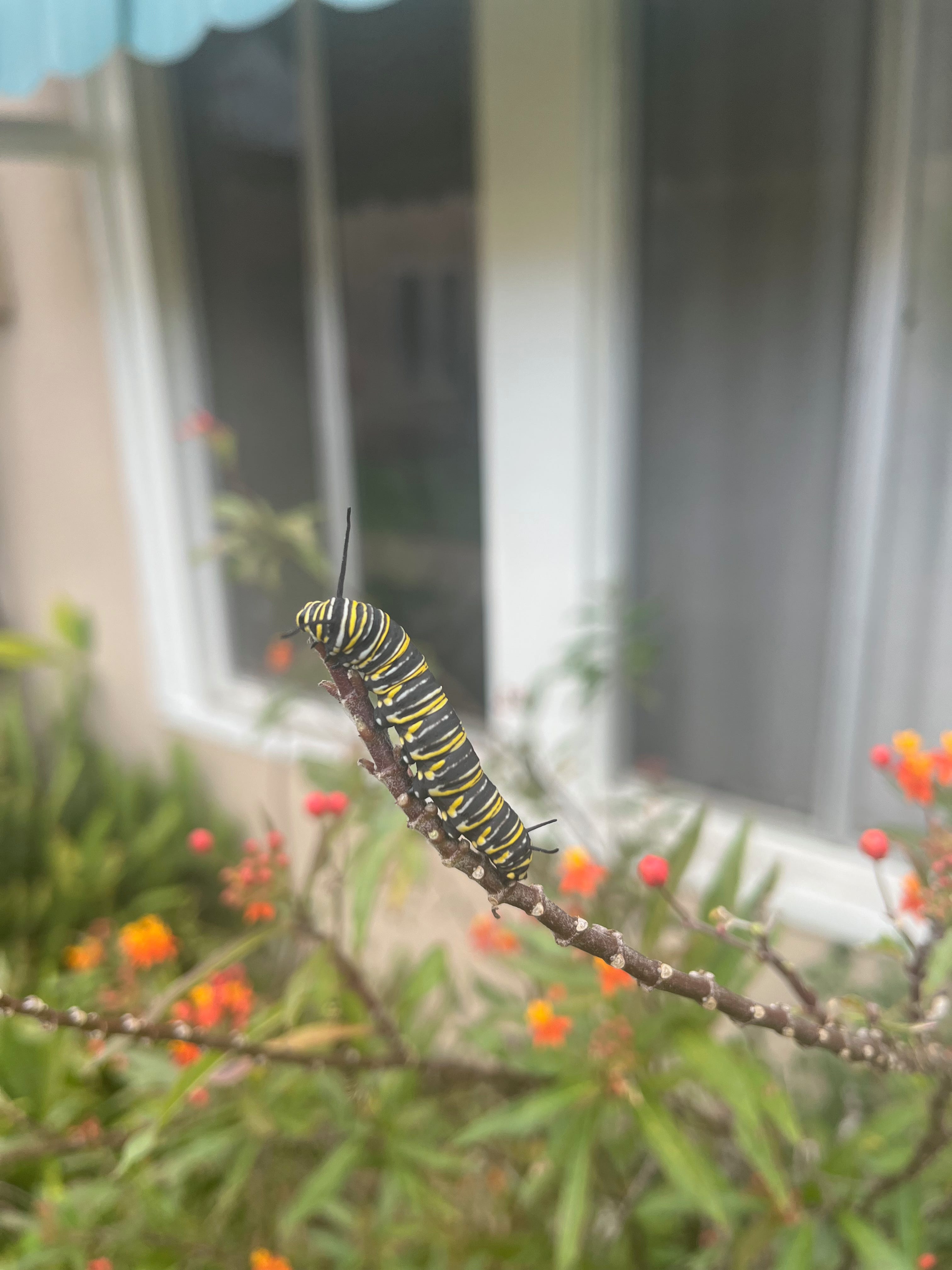
A monarch once landed on this small milkweed plant, laid its eggs on the underside of a leaf, and one of those eggs had hatched into a caterpillar. That caterpillar had eaten every last leaf of that miniature plant before retreating somewhere to metamorphosize. It had hatched, slowly but surely emerging from its chrysalis, before taking its first fledgling flight.
A year later, in the midst of an LA winter, between storms, that mature butterfly returned to this very same spot, and found that native branch missing. I had lost that particular milkweed plant when a wind storm had shattered the pot it was in—the same wind storm, incidentally, that whipped the Altadena and Palos Verdes fires into vast conflagrations. The same fires that displaced so many people from their homes. People who continue to be displaced 14 months later.
***
Non-migratory monarchs, many of which live on the west coast, behave differently. Fluttering from one evergreen milkweed to another, they never feel the need to go on protracted journeys abroad. Perhaps, for a few months in the winter, they will settle their weary bodies on a tall tree and relax. Some west coast monarchs do indeed migrate—up north or inland, searching for the dwindling populations of native milkweeds.
But in a place like Los Angeles, most individuals spend the majority of their lives going from bush to bush, laying eggs, mating, orbiting the same landscape they have never quite felt the need to leave.
Over a lifetime, they may travel a long distance, but never in a linear fashion. Their patterns are haphazard. Disjointed. Aimless. They may visit a few hundred distinct milkweed bushes, but in all that time, their lives are spent circulating a zone that rarely exceeds one square mile.
***
As literary as my notion was—that the monarch deprived itself of a landing because it could not find its natal home—I was wrong.
With a lifespan that does not typically span beyond 6 weeks, the monarch could not have been the same individual that returned to my garden.
I had invented the notion, likely grafted it from what I know of sea turtles, many species of which do return to the same beach they are hatched from.
Humans do this. We return again and again to the nursery of our youth. Home, we call it. The place we were born. The setting that first greeted us into this world.
But not many animals do. It’s perhaps why I latched on to the idea in the first place, why I remember still, this detail about sea turtles whereas I tend to forget most other facts about nature soon after learning them.
Being close to the place of my rearing has often felt compulsory. Like going to school when I was a kid. I am aware, conceptually, that I have a choice in the matter, but it never quite feels that way.
***
The migratory monarchs have a sense of home that is distinct from ours. Their lives—any single generation—is spent in motion. It is spent flocking toward new horizons, following the proliferating scent of blossoms in increasingly richer and richer profusions as the seasons unfold. They come to rest on a spot of particularly entrancing phosphorescence, lay their eggs, and die.
Nevertheless, they do have a home. To the highlands of Mexico, every 5th or 6th generation of migratory monarch returns. It is as if there is a compass bearing imprinted on their DNA, telling them which way to fly. They cannot escape this preternatural urge. Some individuals may divert course, may settle in Texas or Florida, establishing a new legacy.
But most of them, millions upon millions of them, make the entire journey back to the same roosting grounds. They cover the tall sacred fir trees, weighing down their branches, obscuring every last inch of its needle and bark.
***
As I said, I have long struggled with the concept of home.
I find myself still living in the place of my birth. I have left several times in my life, but always returned.
Here is everything I need. A family. A community of friends.
Everything I could want. Restaurants of all kinds. Beautiful women of all kinds. Beautiful landscapes and endless places to explore. Ocean, mountain, desert, movies, bowling, concerts, roller disco, laser-tag…
Pick your poison.
There are a million delights to choose from. Endless blossoms to sample. Why go far, when everything you could possibly need is right here, close at hand?
***
That monarch left the bungalow court as abruptly as it had come. Having never even bothered to land, it simply fluttered away, out between my bungalow and that of my neighbor, up and away. Off to some other, perhaps more fruitful pasture.
The evergreen milkweeds that surround my home are not native. Their origin is hinted at in their scientific name: Asclepias curassavica. The latter part of the name, currassavica, means “of Curaçao”. It’s home is the tropical jungles of the Caribbean, Mexico, and Guatemala—the heartland of the migratory monarchs.
This varietal is popular in gardens because of its evergreen nature. Unlike most milkweeds, it does not die back in the winter. Some scientists have suggested the proliferation of these misplaced varietals has disrupted the habits of migratory monarchs, their profusion of blooms year-round coaxing individuals to abandon their itinerant ways and adopt more sedentary behaviors. It is a compelling narrative, especially concerning an insect with as much celebrity as the monarch. So compelling, in fact, that multiple counties in California have banned the sale of these varietals of milkweed.
And yet, other research suggests this narrative is unlikely, if not complete hogwash.
The truth is, nobody knows.
The monarchs, as befitting their name, follow their own law.
***
My favorite thing about my home is leaving it, and returning to it. Whenever I depart, I feel a sigh of relief.
I felt it the night of the wildfires, when I drove my heaviest car, an 80s era station wagon built from solid steel, to the desert, and marveled along the way as the trees swayed in mad, parabolic gyrations. I felt it last week, when I boarded a plane to Canada, searching for some stillness among these mad and bleak times.
But I also feeel something similar when I, invariably, return to Los Angeles. I watch from the window as my flight descends over the basins and ranges of California’s eastern deserts, which are soon supplanted by the suburban webs of the Inland Empire, which finally drain into the gridded tapestry of Los Angeles proper—its eternal boulevards dying into the horizon, its blocks of warehouses squatting by the channelized river, its diminutive nodes of sky-scrapers looking out over broad alluvial planes of asphalt, concrete, and neat squares of household lawns and gardens. Hills and mountains, the most evocative set piece of this landscape, enclose the city like a boa constrictor slowly asphyxiating its prey
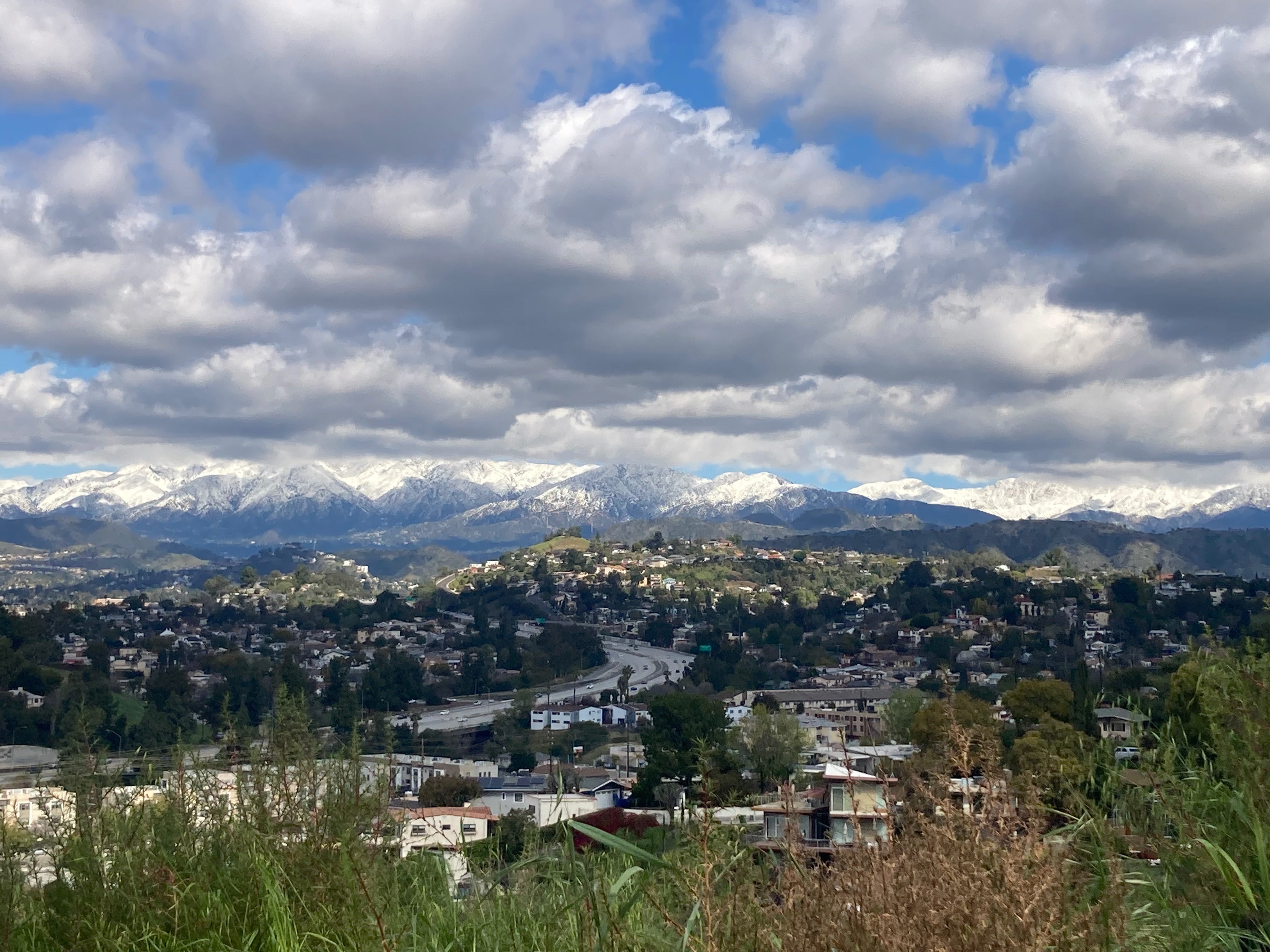
I love this city. I hate this city. I am tired of this city, but always, I am eager to return.
The scene plays out again on the bus, from LAX to Union Station, where I stare out the window at the poorly maintained highways; at the cars—an eclectic mix of beaters and status symbols; at the occasional skyscraper and the mountains ringing the horizon, reassuring in their way. I marvel that this is my home, this place of so much wealth and poverty, beauty and ugliness, creativity and corruption.
I did not choose to be born here. To be raised on a hilltop community in the midst of Northeast LA. To attend an overcrowded public high school and flit away the hours with my friends, playing video games, going to the cinema, and eating pizza. I left as soon as I could fathom I had a choice, after high school. I was still 17.
But I did choose to come back. Reluctantly at first. I was 22. I left again, and then came back again. It was just going to be temporary, I told myself. A year later, I departed once again—not too far away, only a couple hours. Still, once more, I returned. It has now been over 5 years since I’ve truly lived anywhere else.
Likely I will leave again, for a time. As surely as the monarch does. As surely as the sea turtle does. As the salmon, the puffin, the penguin, and the elephant seal do.
It is my home. I did not chose it, nor do I have any choice but to return.
Really beautiful, Nick